
Episode 8: Patterson
Shikari | Season 2

The hot late afternoon Tanganyika sun had been shining on the club porch for some time, taking the heat from a pleasant warmth to a flaccid, humid heat. Small fruit flies buzzed around their ripening flesh, and Covey wiped his brow with a napkin, leaving it soaking. He was on his fifth drink, the surroundings felt lurid and surreal.
Drexler was still looking at him. Covey considered the German’s question. Then said, “What makes you think I want something from Patterson?”
“Your frequent glances in his direction. Also Jacob, and I mean this kindly: you carry the look of a supplicant.”
He glared at Drexler before pushing his chair back. “Pardon me.”
Patterson was indeed at the bar, and miraculously alone. Covey looked back to Drexler and the German nodded in a way that encouraged but did not goad.
“Greetings Colonel. I’m Covey.” He walked up and put out a hand. Closer up, the impressions of time were more apparent on Patterson’s face. The grey in his hair more visible. His face creased and careworn.
“Yes, I spotted you earlier. I wasn’t expecting you to be here, Mr. Covey. Given your reputation.”
“A minute of your time is all I ask for.”
“Which is the most I can spare.”
“Uh, good. Well, my hunting permits have been revoked.”
“A common fate for poachers.”
“Well, I’ve turned over a new leaf. If you put in a good word for me they might reinstate my permits. I’m tracking an elephant that will take me all the way across to Uganda, maybe beyond.”
“Even if I could — which I can’t — why in heaven’s name would I? ”
“As a favour from one hunter to another.”
Patterson took a swig of his drink, before turning away. “You’re not a hunter, mate.”
Covey watched him walk away. The bartender furiously polished an empty glass. His head down. There was no doubt he’d heard every word.
“I take the meeting didn’t go your way,” said Drexler when Covey returned to the table.
“I thought he’d at least consider it. It doesn’t hurt him any. There are are plenty of Englishmen who’ve poached ivory and their permits have been reinstated provided they signed an affidavit to not do it anymore. I’ve signed one too, but I didn’t get to tell him that.”
“You’re a poacher?”
“Every white hunter in Africa has poached one time or another. I’m just one who didn’t get away with it.”
“If you’ve killed animals without permits before, why not continue?”
“It’s not any old elephant. This is a creature that moves around too much. I’m tracking something across game reserves, even borders. Without a permit they’ll throw me in jail.”
“A singular animal.”
“It’s called the Chinkhombero. A great creature. A colossal elephant with four tusks.”
“Do you think the resistance you encounter is because those in positions of authority disbelieve that such an animal exists?”
“I’ve seen it more than once with my own eyes. My gun carrier saw it too.”
“Has such a creature ever been captured or killed?”
“They have a skeleton of one up in New York. A full third of Africa no white man has ever visited. There are tribes living in the deepest jungles of the Congo who have never met with the outside world. Yet all through the continent, the legend of the Chinkhombero stretches. From the shores of the Indian Ocean, the South Seas and the Atlantic. Is it so hard to believe that even if the species has died out elsewhere, one may have survived?”
“I am not a skeptic, Jacob. I only ask questions that others might.”
“Well, none of that matters now, does it? I can’t put a foot on a reserve without Patterson’s help.”
“Perhaps you don’t need him. His ties to East Africa have withered greatly. Do you know what happened in 1908?”
“Wasn’t he involved in some kind of love triangle?”
“He went on safari with a timorous young lordling and his beautiful wife. Except when they returned, the lordling had died during the journey, apparently killing himself with his own gun. But there were whispers of an affair between Patterson and the man’s wife. Rumours of heated words between the two men just before the young noble killed himself in his tent. Later Patterson would say that he buried the body out in the wilds. In the meantime, the wife moved into Patterson’s tent for the rest of the safari.”
“Quite a story.”
“The point is that Patterson is not in a spot to help. The stink of scandal is on him still. He might have been sincere in that expression. But tell me: besides permits, what else do you need to get this expedition going?”
“The permit’s the most important thing. Otherwise movement across borders becomes difficult.”
“Well, there might be ways around that. Some old German ties still endure in these parts. I might be able to help.”
“Why would you do that?”
“I will touch upon that shortly. But first tell me, what else would it take?”
“A proper expedition? Men, pack animals, supplies, time, money.”
“Would a thousand pounds suffice?”
Covey breath stilled. “Three times over. Are you the one to finance it?”
“Join me at the bar for a refresher.”
Drexler bought him another Gin and Tonic, and for himself requested a concoction of pineapple, grenadine and gin called a Princess Kaiulani.
While the bartender busied himself, he slid an envelope over. Through the thin paper, Covey could see the outlines of twenty pound notes.
“A hundred pounds, Jacob. A gift simply for the pleasure of your story-telling.
Covey slid the envelope into his jacket pocket. “And the rest?”
Drexler smiled and took a sip of his drink. He seemed to relish the suspense. “I wish to hear it from you more of that story when we all stood in that convivial circle. Please tell me what you saw in the caldera you visited.”
“It’s a large crater. No white man has visited it before. Even the Masaai avoid it because of some superstition or other other. We tracked a leopard there.”
Drexler’s eyes were unblinking, avid with anticipation, his voice threaded with the steel of command. “Tell me.”
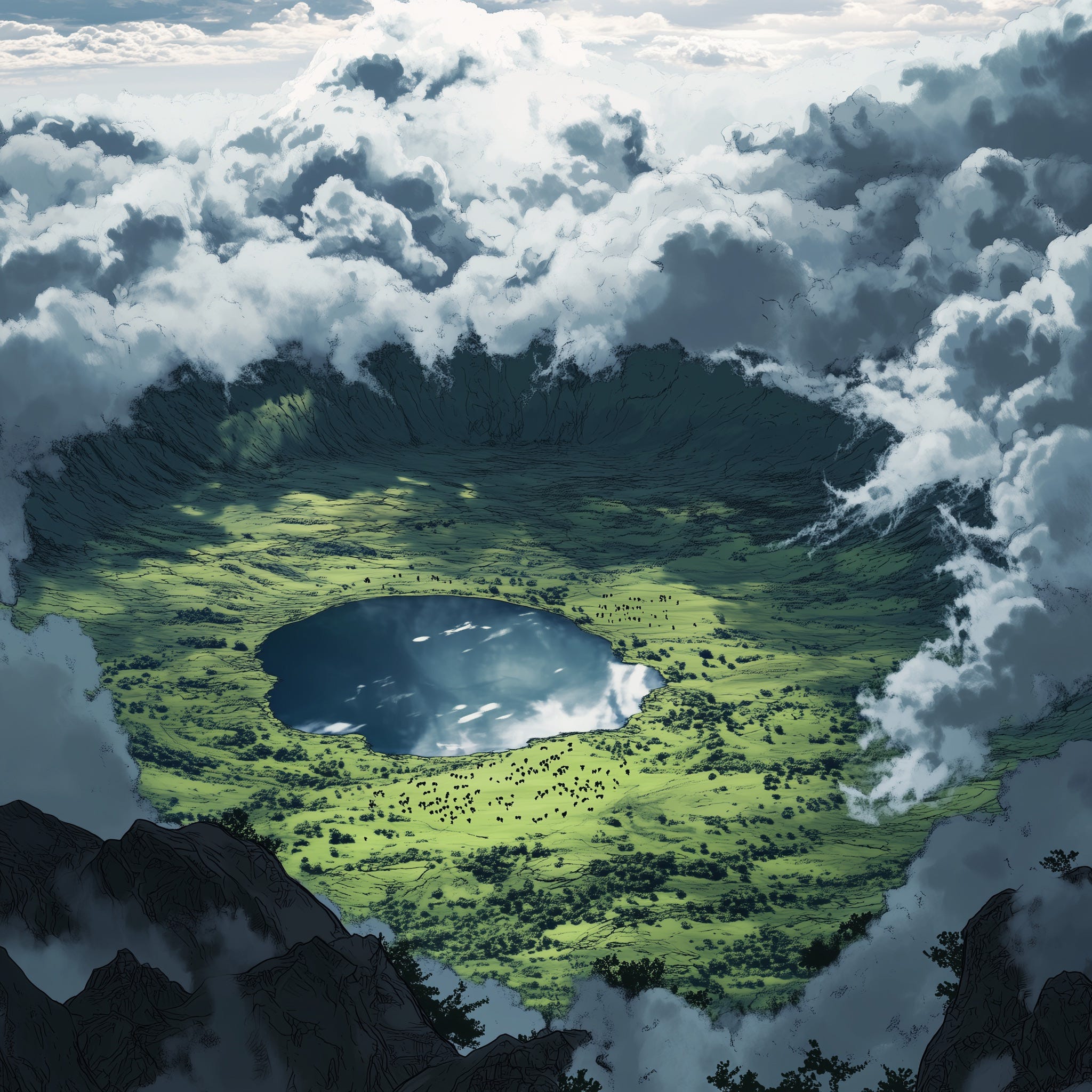
“Only grassland. You could walk across it in a few hours. Just a wide green bowl. It made no sense for the leopard to go up there. It’d been shot, and a climb up that high would have been a great strain on a wounded animal. We were camping there overnight. And in the space of a single night, the grass went from green to red.”
Drexler said it for him, softly. “A caldera whose grass, green the night before, turns blood-red in color overnight. Do you remember the date?”
“Sometime in August. Near the middle of the month. I didn’t keep note.”
“You’re certain?”
“Yes.”
“How long does it take to get there?”
“We have to take a train to Arusha, and from there, on foot and mules, with men. I think a week’s travel in total.”
“I wish for you to take me there. And you will have the remaining nine hundred pounds. Do you remember the way?”
“I do.”
“And are you willing?”
“For a thousand pounds I’ll carry you to hell on my back. But it’ll take time to put a party together. It’s the low season. The porters and guides have found other work now, many have gone back to their kraals.”
A waiter came to their table to collect their empty glasses. “Will sirs be having anything else?”
“No,” said Covey and when the man didn’t leave he looked up, frowning. “Oh, right.” He scrounged around his pocket with a studied inefficiency to give Drexler a chance to intervene. When the German didn’t, Covey set a couple of shillings on the table with some reluctance, but the waiter made no move to take it. Instead, he leaned down. Spoke in low tones. “Sorry, sir. I heard you saying that you need camp men for Arusha?”
“What of it?”
“Well, sir. I may know of someone who can help.”