
Episode 7: Bertrand
Shikari | Season 2

On the train, Sirit brought out a copy of This Side Of Paradise from the rucksack to read. Below the brim of her black cloche, her eyes, that startling amber transitioning to gold, were flicking left to right, the only ambulant citizens on a stone-still head. She was a quick reader.
Kiran shifted; the leather under him was cracked and old. Stiff horsehair poked out of it. The wooden slats above chattered as though cold like all the other passengers. The carriage, dirty and dingy, was an inexplicably ancient link in a line of otherwise modern cars. This was far from a Pullman coach.
When he cleared his throat she seemed surprised to see him there, as though he were an old friend who had gotten on the same train car and sat down before her. “Are you quite alright, Mr. Rao?”
He shook his head. “No, I feel as though I am in some dream. Is all this…is all this really happening?”
“Unfortunately, it is.”
“You won’t tell me who sent you?”
“That is one of the conditions of my employment.”
“Why?”
“It would put us both in danger.”
“But half of Cambridge has already seen us.”
“Seen, not heard.”
“The police know about us.”
“Is that a bad thing?”
“It is bad to escape arrest.”
“It was never mentioned that we were under it.”
He shook his head in frustration. “And why in God’s are you looking for William Mohan?”
“Because that is what we do for those who are missing. You attended his school. He was your teacher. Aren’t you curious as to what happened to him? ”
He did. He was. So why wasn’t he?
“I have only your word that he is missing.”
“And I suppose right now that word is worth little.” Sirit nodded thoughtfully. A small smile played on her lips before she returned to reading.
He tried to keep quiet, but could not. “And you’re the one meant to protect me?”
“To find and protect, in that order.”
“I mean no offence by this, but how? You are by yourself, and a woman.”
Sirit looked up, appearing shaken by his words. She opened her mouth to speak, then closed it. She put the book away and gazed out the window, where the Essex countryside unspooled in a light green reel. Just as he was about to apologize, she looked back as though the English landscape had provided her with the words she was looking for. Her hands on the table, she leaned forward until Kiran flinched, realizing, in that it could engender only fear or love, and nothing in between, her face was that of a God’s.
“Because I have capacities you cannot imagine,” said Sirit.
*
The townhouses on Sydney Street in Chelsea had juliet balconies jutting above narrow, black doors. When Sirit knocked on one numbered 31 a young woman of small stature opened the door. Her shift dress was a deep green, and her dark hair was tied into chignons on the side of her head. She stared up at them mutely.
“We’re here for Lord Russell,” interjected Sirit. “I know we’re not expected, Ms. Black, but is he in?”
Shocked, Kiran turned to Sirit. “See who?”
No less stunned was the woman named Black. “Yes but, how did you…”
“My name is Sirit. And this is Kiran Rao.” Sirit smiled and extended a hand. Dora Black shook it reflexively. Keeping her eyes on them, she called out. “You have visitors, Bertrand.” She stepped aside, as though remembering her manners. “He’s in his study, but I’m sure he heard me.”
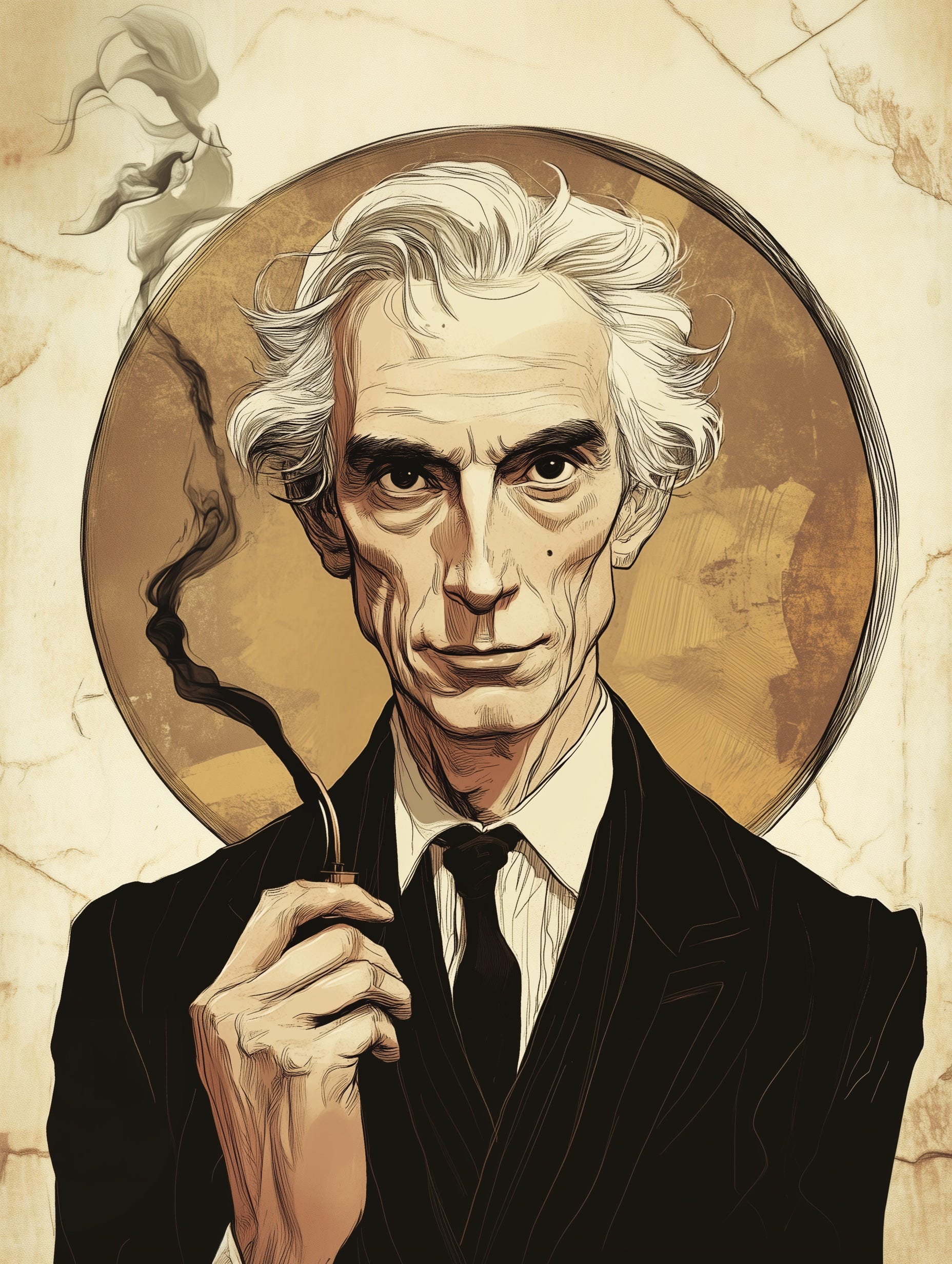
They were led to a modest salon where small wingback chairs were set around a large, Turkish carpet. It was dim; the lace curtains on the windows lent a hoary cast to the morning light streaming in. The scent of cinnamon and orange peel came from the low fire burning in the tall, marble-mantled fireplace. At the far end, a long wood table laden with disheveled stacks of books and papers lined one wall. Closer to them was a divan and a coffee table on which a magazine was open. Kiran realized that it was here that Dora Black must have been sitting when they knocked on the door. That woman now stood at the entrance, squeezing the fingers of her right hand in her left, as a man walked around her, giving her shoulder an affectionate squeeze. He was in his fifties, slight and handsome, with a prominent nose and longish, greying, hair parted with a neatness no longer in fashion.
He removed the pipe from his mouth once he saw them. “Two more extraordinary faces I could not have imagined when I woke up this morning. How may I help you?”
Kiran stood, awed by Bertrand Russell’s presence. Sirit had also risen to greet the man with respect but not reverence in her manner. In fact, she was cuffing the sleeve of her left arm as she spoke. “Lord Russell. My name is Sirit, and this is Kiran Rao of Cambridge, he is reading in Literature.” She took off her wristwatch and turned her wrist over. “I fear we need your help.”
Russell stared at Sirit’s wrist, growing pale as he did so. “Please come into my study.”
*
Russell’s study was small but the space was efficiently used. Book-packed shelves were built into the walls and reached the ceiling. A shaded electric lamp cast an effulgent, green glow on the leather topped desk.
Russell locked the doors and drew the curtains. He sat down heavily on the other side of the desk. The jovial air he carried initially was gone. Kiran saw his hand shake as he lit his pipe. “If you won’t consider my request too improper, madam, I must again see your wrist.”
Sirit submitted her arm to the warm electric light. Russell and Kiran both gawked at the mark on it before they, as though telepathically aware of the impropriety of the act, caught each other’s eyes and blushed.
The strange symbol on Sirit’s wrist was no more than a diameter. The nine points formed by three interlocking triangles, or as Kiran would later think of it, nine sets of hands, emerging from a central locus, joined together in the ancient greeting of the Anjali Mudra.
Russell sat back and took a deep puff on his pipe. The smoke wreathed above his head like a turban. “I never thought I’d see one of those again.”
“We seek a man named Major William Mohan.”
“I have little intercourse with military types, as should be obvious.”
“He’s an accomplished hunter, Eurasian, born and settled in Kumaon and Garhwal, India, near the Nepal border. He’s also a writer of growing popularity. Mr. Mohan left the country with his sister, Mary, three months ago under adverse circumstances. His last ascertained whereabouts were Tanganyika, followed by London. We’ve not been able to trace him since. Mr. Rao is known to Mr. Mohan and will assist me in the search for his whereabouts.”
Russell seemed increasingly relieved. “Well, there’s little I can do for such a matter. After all, as I said, I don’t know William Mohan.”
Sirit looked at Russell evenly, and Kiran saw, with even greater awe than when he met the man, to see him squirm. “Those I work for assured me of your help, Lord Russell, if only for the sake of reciprocity.”
Russell nodded, chastened. “Please continue.”
Sirit turned to Kiran. “You raised a good point earlier in the train, Mr. Rao. It’s best for us to avoid undue attention for now. May I secret you with Lord Russell for a time?”
Russell’s eyes flicked from Sirit’s face to Kiran’s. “And why would you need to do that?”
Kiran cleared his throat. “Sir, we are — as the saying goes — on the run.”
“Then that’s…reasonable. Are you amenable to this, Mr. Rao?”
Kiran could only shrug. A twig in a waterfall. It was time to close his eyes and take the plunge and hope he would wake up before long. “I suppose I have no objections.”
“How long are we talking here?” Russell asked Sirit, who was putting her wristwatch back on. She smiled. “Just as long as it takes you to call a gathering of close friends.” She handed him a list of names. One was underlined. “This one guest is essential.”
As she made no attempts to hide it, Kiran leaned over the read the names, some were well-known enough to raise his eyebrows, but the name underlined was only vaguely familiar.
Russell was frowning. “They’re friends, but you misunderstand how close they are. I promise to do my best.” He pointed at the underlined name. “Why her in particular?”
Because what she holds can lead us to Major Mohan.”
“Then why the others?”
Sirit was rising, ready to take her leave. “Something I was taught early in my training, Lord Russell: there’s safety in numbers.”
“Wait,” Russell took out a journal. He dipped a fountain pen in the ink pot and wrote an address on a page and ripped it out. “Meet us here this evening at eight. Extraordinarily short notice but I’ll emphasize the importance of the gathering to those invited.”
Sirit’s glanced at the page and nodded. “Kindly burn it, Lord Russell.”
As she departed, Russell leaned back, some imperiousness returning to his manners. He gave out a great puff of smoke as he scrutinized the man before him. “So, reading in English, eh?”
“Yes, sir. Second and final year of my Masters.”
“You have a title for your thesis?”
“The Enduring Appeal of Shakespeare in India.”
Russell muttered the title to an invisible entity on the ceiling. He looked down. “And you can attest to this appeal?”
“In the schools in India that are instructed in the medium of English, children are taught to love him at an early age.”
“Taught…to…love,” Russell chuckled. “I can think of no worse fate for a writer. I don’t think the bard wrote with a view towards boring school children; he wrote with a view to delighting his audiences. If Shakespeare does not give you delight, you best ignore him.”
They are on the hills. The entire school. The grasses shot with wildflowers. Dusk falling. Cattle lowing. They’ve hung lanterns on the branches. Mohan is there in the robes of Theseus. Mary is Hippolyta. Another boy - Puck. A wreath of Ashwatha leaves on his head. He is Demetrius. Hermia is there. And he loves her. So much his heart could burst. But she loves Lysander. At the edge of the wood: a hulking man hidden in twilit shadows. Long ears. Snout. Fur on his face. Nick Bottom? Why can’t he remember? A memory under glass. To be admired but not touched.
“Are you quite alright, Mr. Rao?”
He managed to nod. “Yes, sir. I am. Thankfully, delight is what Shakespeare gives me.”
“A great relief, for it must have made your work on the thesis easier. But for now, can I at least offer you some tea and biscuits?”
Kiran nodded. “As you please, sir. And if you’re so kind, some answers, beginning with the symbol on Sirit’s wrist.”
“She has not told you who she works for?”
“She claims it is forbidden for her to do so, but I understand that you are not under such restrictions.”
“Very well, Mr. Rao.” Russell leaned forward and beckoned him to come closer. The air in the room grew heavy and charged, swirled as it does in the mountains. The portent of a furious storm. “The star on her wrist marks her as an agent of The Nine Unknown, a cabal of the most ancient, secretive and powerful individuals in the history of human civilization.”